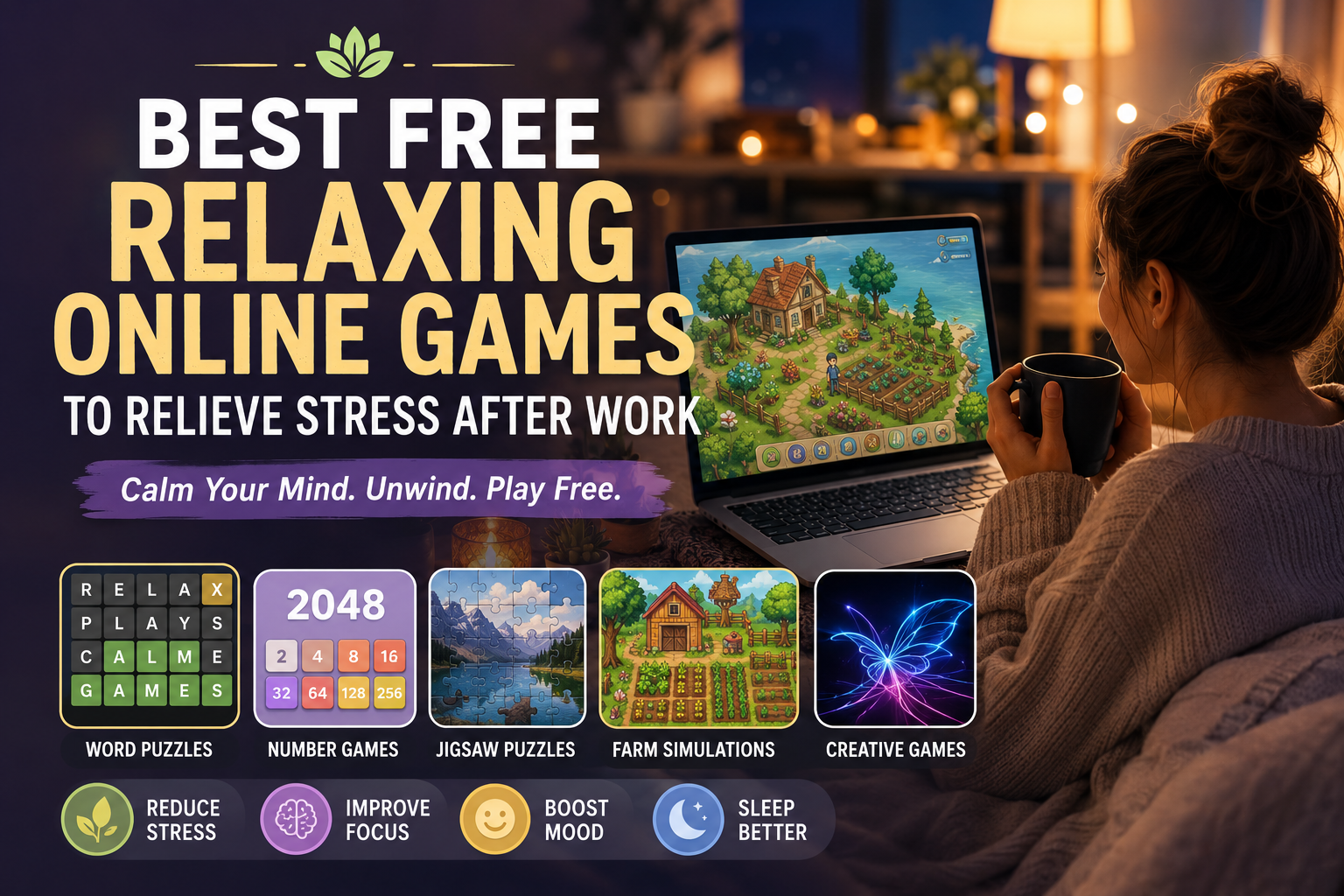
Best Free Relaxing Online Games After Work
After a long workday filled with deadlines, endless notifications, meetings, assignments, traffic, and mental exhaustion, most people don’t want more pressure. They want escape. They want calm. They want something simple that helps the mind slow down without demanding too much energy.
That’s exactly why free relaxing online games have become one of the biggest digital wellness trends worldwide.
Over the last few years, millions of adults, students, office workers, and remote employees have quietly replaced stressful evening habits like doomscrolling and binge-watching with calming browser games, cozy simulation games, and relaxing puzzle experiences. These games are not about competition or winning. They are about mental recovery.
The best relaxing games online create a safe mental space where your brain can breathe again. Instead of overwhelming your senses, they gently engage your attention through peaceful visuals, satisfying mechanics, soft audio, and low-pressure gameplay.
Whether it’s organizing puzzle pieces, growing crops on a virtual farm, building tiny seaside towns, solving a relaxing word puzzle, or simply creating glowing digital art, these games help reduce mental clutter in surprisingly effective ways.
What makes these experiences even better is accessibility. Most of the best free relaxing online games after work require no downloads, no expensive gaming PC, and no complicated setup. You open your browser, click play, and within seconds your stress levels begin to ease.
For people dealing with burnout, anxiety, emotional fatigue, or overstimulation, these calming browser games for stress relief can provide short but meaningful moments of peace during busy evenings.
In this guide, we’ll explore the most relaxing online games available today, why they work psychologically, and how to choose the right game for your mood and mental state.
Why Free Relaxing Online Games Are Becoming So Popular
Modern life is mentally exhausting in ways previous generations never experienced. Most people spend their entire day processing information, answering messages, switching between tasks, and constantly reacting to digital interruptions.
By evening, the brain becomes overloaded.
That’s why many adults are actively searching for healthier ways to unwind. Instead of consuming more stressful content online, people are turning toward free stress relief games and peaceful digital experiences that promote calmness and emotional balance.
Psychologists often describe this effect as “gentle cognitive engagement.” Relaxing games occupy the brain just enough to interrupt anxious thinking patterns without creating additional pressure. Unlike competitive multiplayer games that trigger adrenaline and frustration, calming games create slow and satisfying mental rhythms.
Research published in recreational psychology studies has shown that low-stakes gaming can reduce perceived stress and improve emotional regulation. Simple activities like sorting, organizing, matching, decorating, and repetitive clicking activate reward systems in the brain while lowering mental tension.
This is one reason why free casual games for adults have exploded in popularity across countries like the United States, Canada, Australia, the United Kingdom, and Pakistan. People are no longer viewing games purely as entertainment. They are beginning to see them as digital self-care tools.
The rise of the “cozy gaming” trend also reflects this shift. Cozy games focus on comfort instead of competition. They remove aggressive mechanics and replace them with peaceful exploration, farming, decorating, creativity, and gentle progression systems.
Another major factor is accessibility. Most peaceful online games can now run directly inside a web browser on laptops, tablets, or smartphones. There’s no friction, no installation process, and no financial commitment. That simplicity matters when someone is mentally exhausted after work.
The popularity of relaxing games for anxiety and burnout also increased dramatically during remote work expansion. Many remote workers found themselves struggling to mentally separate work from personal life. Relaxing browser games became a simple transition ritual between productivity and rest.
In many ways, these games function like interactive meditation. They provide focus without pressure, stimulation without stress, and engagement without emotional exhaustion.
Best Relaxing Puzzle Games for Adults Online
Puzzle games remain one of the most effective forms of digital relaxation because they redirect mental energy toward small, manageable tasks. They quiet racing thoughts while creating satisfying moments of completion and order.
For adults dealing with work stress or mental fatigue, relaxing puzzle games for adults online can feel surprisingly therapeutic.
One of the most popular examples is Wordle. The game’s simplicity is its strength. You solve one five-letter word puzzle daily, and then the experience ends. There’s no pressure to continue endlessly. This daily structure creates a comforting ritual that millions of players now use as part of their evening routine.
Connections is another powerful example. Instead of relying on speed or reflexes, it rewards pattern recognition and creative thinking. The game feels intellectually stimulating without becoming emotionally draining.
Number-based puzzle games like 2048 are also remarkably calming. Sliding tiles across a small grid sounds simple, but the repetitive movement and predictable logic create a meditative rhythm. Because there’s no timer, players naturally relax into the gameplay rather than feeling pressured.
Digital jigsaw puzzle platforms such as Jigsaw Planet and Jigsaw Explorer provide another layer of calm. Research has shown that visual sorting activities help promote mindfulness by narrowing attention toward repetitive, focused tasks. Searching for matching puzzle edges and colors encourages the brain to slow down naturally.
What makes puzzle games particularly effective is their sense of closure. Modern life often feels emotionally unfinished. Emails remain unanswered. Tasks pile up endlessly. Notifications never stop. Puzzle games provide something rare: completion.
Every solved word, completed image, or merged tile gives the brain a small reward signal that feels emotionally satisfying.
These games are especially beneficial for people whose stress appears as racing thoughts or overthinking. Instead of spiraling mentally through worries and responsibilities, the mind becomes occupied with manageable, low-stakes challenges.
That’s why puzzle experiences consistently rank among the best casual games for mental relaxation and continue growing across mobile and browser gaming platforms worldwide.
Cozy Simulation Games That Help Reduce Anxiety
Few gaming genres feel as emotionally comforting as cozy simulation games. Unlike action games that demand constant reaction and performance, relaxing simulation games focus on routine, nurturing, creativity, and peaceful progression.
This genre has become one of the strongest trends in modern gaming culture because it provides emotional comfort in ways many people didn’t realize they needed.
Farming simulations are perhaps the most recognizable example. Games inspired by Stardew Valley allow players to plant crops, decorate spaces, collect resources, and interact with friendly communities at their own pace.
There’s something deeply calming about tending virtual plants after a stressful day.
The appeal comes from predictability and gentle reward systems. In real life, stress often feels chaotic and uncontrollable. In cozy farming games for relaxation, actions produce reliable positive outcomes. You water crops, they grow. You organize your space, it becomes beautiful. This predictable feedback loop creates emotional stability.
Farm RPG and similar browser-based farming experiences are excellent examples of free cozy games to reduce anxiety because they remove pressure almost entirely. There are no aggressive fail states, no competitive rankings, and no punishing mechanics.
Idle games like Cookie Clicker operate differently but achieve similar emotional effects. These games reward passive progress rather than intense effort. Numbers slowly increase over time, upgrades unlock automatically, and progress continues even while you’re away.
That passive progression can feel incredibly comforting after mentally demanding workdays.
For emotionally exhausted players, idle games reduce decision fatigue because they require minimal cognitive energy. Instead of constant problem-solving, players simply observe growth and progression.
Townscaper represents another form of relaxing simulation. It removes traditional game systems entirely and focuses only on peaceful creation. You click to place buildings, and the game automatically generates charming seaside architecture. No objectives. No timers. No enemies.
Many players describe these experiences as “digital comfort food.” They create emotional softness instead of stimulation.
This emotional comfort explains why relaxing simulation games have become increasingly popular among adults experiencing burnout, workplace stress, and anxiety-related fatigue.
Peaceful Browser Games That Calm the Mind
Some of the most effective stress relief games barely qualify as traditional games at all. Instead, they function more like interactive relaxation environments designed to quiet the nervous system.
These peaceful browser games with no ads focus less on achievement and more on sensory experience.
Silk is one of the best examples. The experience allows users to create glowing symmetrical artwork simply by moving the cursor across the screen. There are no instructions, scores, or objectives. Just movement, color, and visual flow.
Despite its simplicity, Silk feels deeply meditative.
The reason is psychological. Repetitive motion combined with visual symmetry naturally calms the brain. The experience resembles mindfulness exercises because it narrows attention toward the present moment instead of future worries.
Blob Opera offers a completely different kind of emotional relief. Players control singing animated blobs that harmonize automatically using machine-learning-generated opera vocals. The result is playful, musical, and unexpectedly joyful.
After emotionally draining days, joy itself becomes therapeutic.
Not everyone needs silence to relax. Some people need playfulness, surprise, or creativity to break negative emotional patterns. Blob Opera succeeds because it encourages experimentation without judgment or pressure.
Creative sandbox games like Patterned and Townscaper also fall into this category because they focus on aesthetic pleasure instead of challenge. Beautiful visuals, soft sounds, and tactile interactions activate positive emotional responses while reducing cognitive overload.
One important reason these calming browser games for stress relief work so well is accessibility. Many mindfulness apps feel formal or difficult to maintain consistently. Relaxing games feel natural and enjoyable instead of therapeutic.
People often resist self-care routines when they feel like obligations. Relaxing games avoid that problem entirely because they create calm indirectly through enjoyment.
This is why many therapists and mental wellness advocates increasingly acknowledge the value of low-pressure gaming experiences for emotional recovery and stress management.
How to Choose the Best Relaxing Online Game for Your Mood
Not all stress feels the same, and different emotional states require different types of relaxation.
If your brain feels overstimulated and unable to stop thinking, puzzle games are usually the best option. Word games, number puzzles, and matching mechanics redirect mental energy toward manageable tasks that interrupt overthinking patterns.
Games like Wordle, Connections, and 2048 work especially well for mentally restless players because they provide structure and closure.
If you feel emotionally drained rather than mentally overloaded, cozy simulation games are often more effective. Farming games, idle games, and sandbox builders require less concentration while still providing emotional warmth and satisfying progression.
For players experiencing anxiety and burnout, peaceful simulation experiences create emotional softness instead of stimulation.
If you simply want joy or creative freedom, ambient browser games like Silk or Blob Opera may feel surprisingly restorative. These experiences encourage experimentation, curiosity, and playfulness without pressure or expectations.
Time also matters. Many adults only have ten or fifteen minutes available during evenings. Daily puzzle formats work extremely well in these situations because they create healthy stopping points.
Another important factor is sensory preference. Some people relax through visuals and creativity. Others prefer logic and organization. Some need silence, while others respond positively to music and playful sounds.
Understanding your emotional state helps you choose the most effective relaxation experience.
Ultimately, the goal is not endless distraction. The goal is recovery.
The best free online games to relax your mind create enough engagement to interrupt stress without creating new tension. When chosen intentionally, these experiences can become valuable tools for maintaining emotional balance in an increasingly overwhelming digital world.
Conclusion
Modern life rarely gives the brain a true opportunity to slow down. Even during free time, most people remain mentally overloaded by endless information, social media feeds, notifications, and digital pressure.
That’s why relaxing online games matter more than ever.
The best calming games are not about competition or escape through intensity. They are about creating small moments of peace. Whether you’re solving a gentle puzzle, building a tiny digital town, growing virtual crops, or simply creating glowing art on a screen, these experiences help your mind transition away from stress.
For office workers, students, remote employees, casual gamers, and anyone dealing with anxiety or burnout, these low-pressure experiences can become powerful evening rituals.
Sometimes, all you really need after a difficult day is ten quiet minutes where nothing is demanding anything from you.
And often, the right relaxing game can provide exactly that.
Frequently Asked Questions (FAQs)
1. What are the best free relaxing online games after work?
Popular options include Wordle, 2048, Cookie Clicker, Townscaper, Blob Opera, Silk, and Farm RPG.
2. Are relaxing browser games good for stress relief?
Yes. Low-pressure games can help reduce mental fatigue, calm racing thoughts, and improve emotional relaxation.
3. What are the best calming browser games for stress relief?
Silk, 2048, Townscaper, and Jigsaw Planet are among the most calming browser-based games available.
4. Can relaxing online games help anxiety?
They may help temporarily reduce anxious thoughts by encouraging focus, mindfulness, and gentle cognitive engagement.
5. What are the best free cozy games to reduce anxiety?
Farm RPG, Townscaper, Stardew Valley-inspired games, and relaxing idle games are excellent choices.
6. Are there peaceful browser games with no ads?
Yes. Silk, Cookie Clicker, 2048, and several puzzle-based browser games offer minimal interruptions.
7. Why are puzzle games relaxing?
Puzzle games create manageable goals and satisfying completion loops that help redirect overthinking and mental stress.
8. What are the best stress relief games to play at night?
Wordle, Connections, relaxing jigsaw puzzles, and cozy farming simulations are ideal nighttime choices.
9. Are relaxing games suitable for adults?
Absolutely. Many relaxing games are specifically popular among working adults dealing with burnout and mental fatigue.
10. How long should I play relaxing games daily?
Most experts recommend 20–45 minutes of casual gaming for healthy stress relief without overstimulation.