
When Big Promises Meet Bigger Realities
Imagine pledging to climb Everest, only to discover midway through that someone quietly moved the summit ten thousand feet higher. That is precisely the situation Microsoft finds itself in today.
In 2020, Microsoft made what many called the most ambitious corporate climate commitment in Big Tech history. The company vowed to become carbon negative by 2030 and, in 2021, doubled down with its bold 100/100/0 pledge: matching 100 percent of its electricity consumption, 100 percent of the time, with zero-carbon energy purchases. Industry analysts praised it. Climate advocates applauded it. Shareholders cited it as proof that profit and planet could coexist.
Then came the artificial intelligence revolution, and with it, a data center boom of almost incomprehensible scale.
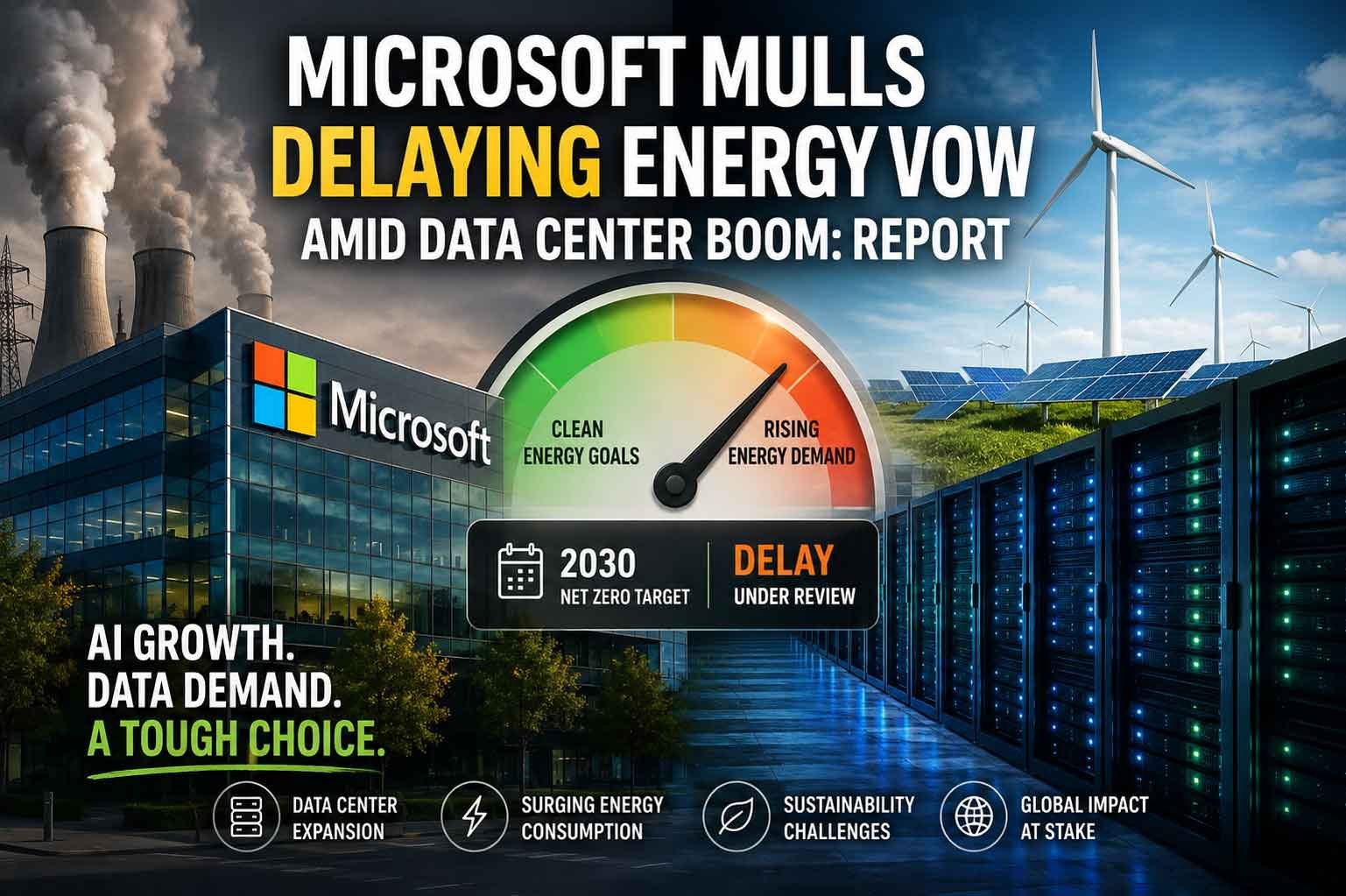
According to a Bloomberg report published in May 2026, Microsoft is now weighing whether to delay, or even abandon altogether, its 2030 target of matching 100 percent of its hourly electricity use with renewable energy purchases. The reason is as straightforward as it is alarming: the energy demands of AI-driven data centers have grown so fast and so large that the original sustainability math no longer adds up.
This development is not just a Microsoft story. It is a defining moment for every major technology company, every climate policymaker, every investor who has ever priced in a company’s ESG commitments, and every person who believes that the tech sector should lead the world toward a cleaner future. The questions this raises are urgent: Why is Microsoft considering delaying its energy sustainability pledge? What does the data center boom have to do with it? And what does this mean for the broader promise of green technology?
This article answers all of those questions, in full, with data, context, and a clear look at what comes next.
The Original Pledge: What Microsoft Promised the World
To understand why a potential delay matters so much, you have to first appreciate just how significant Microsoft‘s original commitments were.
In January 2020, CEO Satya Nadella stood before the world and announced a sweeping sustainability agenda. By 2025, Microsoft would shift to 100 percent renewable energy supply for all its data centers, buildings, and campuses. By 2030, the company would become carbon negative, meaning it would remove more carbon from the atmosphere than it emits. And by 2050, Microsoft would erase all the carbon it had ever historically produced since its founding in 1975.
Then, in 2021, Microsoft added even greater ambition with the 100/100/0 vision. Unlike many corporate renewable energy pledges that simply match annual consumption with annual renewable purchases, the 100/100/0 commitment required hour-by-hour matching. This means that every single hour of every day, the clean energy Microsoft purchases must come from the same power grid where its facilities are drawing electricity. It is, by any measure, one of the most technically rigorous and demanding clean energy standards ever adopted by a private company.
To back these pledges, Microsoft invested at an extraordinary scale. The company secured more than 40 gigawatts of new renewable energy capacity across 26 countries through over 400 contracts and partnerships with more than 95 utilities and developers. In 2024 alone, it signed a landmark $10 billion deal with Brookfield Asset Management to supply 10.5 gigawatts of renewable power between 2026 and 2030, described at the time as the largest clean energy deal ever signed. Microsoft also inked a $6.2 billion agreement for 100 percent renewable-powered AI computing capacity in Norway, tapping the country’s abundant hydropower.
By early 2026, Microsoft could rightly claim that it had matched 100 percent of its annual global electricity consumption with renewable energy, meeting its 2025 annual target. That was a genuine milestone, 13 years in the making and representing a massive financial and logistical investment.
But here is where the story turns. Annual matching is one thing. Hourly matching, around the clock, at a scale that now includes a tidal wave of AI workloads, is another challenge entirely. And it is that harder, more ambitious target that now sits in doubt.
The Data Center Boom: Numbers That Change Everything
The scale of Microsoft data center expansion over the past three years has been, by any reasonable definition, staggering. And the numbers behind this expansion are what make the Microsoft energy pledge delay discussion not just understandable, but perhaps inevitable.
Microsoft announced it would spend $80 billion on data center infrastructure in fiscal year 2025 alone. That figure is not a typo. Eighty billion dollars. In a single fiscal year. To put it in perspective, that sum exceeds the entire annual GDP of many small nations. This investment reflects a deliberate, aggressive strategy to build the computational backbone that AI services, from the Azure cloud platform to Copilot AI assistants, require to function at global scale.
The consequence for energy demand has been proportional. Between fiscal year 2020 and fiscal year 2024, Microsoft‘s energy use increased by 168 percent. During the same period, the company’s revenue grew by 71 percent. In other words, energy consumption grew more than twice as fast as revenue. The data center electricity usage curve is not just rising; it is steepening.
The carbon impact has been equally stark. Microsoft‘s own 2025 Environmental Sustainability Report revealed that its total greenhouse gas emissions increased 23.4 percent compared to its 2020 baseline. Some analyses, including those from environmental research group Stand.earth, place the cumulative increase closer to 30 percent. The company’s Scope 3 emissions, which cover supply chain and capital expenditures like the steel and concrete used to build data centers, now represent more than 97 percent of Microsoft‘s total carbon footprint and rose 26 percent over the five-year period.
The International Energy Agency projects that global data center electricity demand will more than double between 2025 and 2030. Goldman Sachs Research estimates data center power demand will grow 160 percent by 2030, at which point data centers could account for 3 to 4 percent of all global power consumption. A single AI-powered query, such as one processed by Microsoft‘s Copilot, consumes roughly 10 times the electricity of a standard Google search, according to Goldman Sachs analysis. That ratio, multiplied by billions of daily queries, produces energy demand figures that dwarf anything Microsoft modeled when it made its sustainability commitments in 2020 and 2021.
The AI data center power demand problem is not unique to Microsoft. Google reported that its own emissions grew nearly 50 percent over the five years through 2024, driven by exactly the same forces. But Microsoft, as both the largest enterprise cloud provider and the most prominent corporate backer of OpenAI, sits at the absolute center of this tension.
Why the 100/100/0 Target Is Under Threat
The specific pledge under review is the 100/100/0 commitment, and understanding why it is so difficult to honor helps explain why Microsoft‘s leadership is reportedly reconsidering it.
Annual renewable energy matching, which Microsoft achieved in 2025, works roughly like this: over the course of a year, Microsoft purchases enough renewable energy certificates and power purchase agreements to equal its total annual electricity consumption. If Microsoft uses 100 units of electricity in a year and buys 100 units of renewable energy, the annual books balance, even if some of that renewable energy was produced at a different time or in a different location than when and where it was consumed.
The 100/100/0 model is fundamentally different and far more demanding. It requires that at every hour of every day, the renewable energy being fed into a given power grid must match what Microsoft‘s facilities on that same grid are drawing. This requires continuous real-time monitoring, an enormous portfolio of geographically distributed clean energy sources, and access to energy storage and dispatchable clean power, such as nuclear, geothermal, or battery-backed solar, that can supply electricity at any hour regardless of whether the sun is shining or the wind is blowing.
The Microsoft sustainability goals were calibrated to a company that was growing steadily and predictably. The AI revolution has made growth anything but predictable. New data centers come online in months. Capacity expands in giant leaps. And every new facility, operating 24 hours a day, must be covered by the right amount of clean energy at the right hour on the right grid. Sourcing sufficient dispatchable, zero-carbon power to meet that standard, at the pace Microsoft is now building, has become operationally and financially daunting.
Stand.earth’s research adds another dimension to the challenge. The organization found that Microsoft has announced multiple agreements for methane gas-powered on-site generation to support new data center capacity, with combined capacity of approximately 4.75 gigawatts. If those projects proceed as planned, they project that Microsoft‘s data center carbon footprint could increase by 160 percent, reaching roughly 25.25 million metric tons of CO2 equivalent by 2028. That trajectory is incompatible with the 100/100/0 target.
Microsoft President Brad Smith has acknowledged the difficulty directly, using a striking metaphor: “In 2020, Microsoft leaders referred to our moonshot goal of being carbon negative by 2030. Nearly five years later, we have had to acknowledge that the moon has gotten further away.”
Big Tech’s Broader Sustainability Crisis
Microsoft‘s dilemma is the most visible face of a challenge that extends across the entire green energy commitments tech industry landscape. The Big Tech energy consumption problem is structural, not incidental.
Every major cloud provider and AI infrastructure operator is grappling with the same fundamental conflict: the demand for AI compute is growing faster than the clean energy supply needed to power it. And because AI capabilities are a strategic existential priority for all of these companies, the energy question tends to yield in the competition for corporate resources and attention.
The numbers illuminate the problem. Data centers globally are now estimated to consume between 1 and 2 percent of the world’s total electricity, a figure projected to rise sharply as AI workloads multiply. Nvidia’s flagship data center GPUs, the H100 and H200 chips that power large language model training and inference, consume between 300 and 700 watts each. A single large-scale AI training cluster might contain tens of thousands of these chips running continuously.
The renewable energy supply chain cannot currently keep pace. Solar and wind projects face interconnection queue backlogs that in some regions stretch five to ten years. New nuclear capacity, which could provide the dispatchable zero-carbon power AI data centers need, typically takes a decade or more to bring online. Transmission infrastructure, the physical grid needed to move clean electricity from where it is generated to where it is consumed, is severely underdeveloped in most of the world.
Google, Amazon, Meta, and Microsoft have collectively invested tens of billions in clean energy. They have restarted conversations about advanced nuclear, pushed utilities to accelerate grid modernization, and explored technologies from offshore wind to geothermal. But even these titanic investments are struggling to outrun the pace of AI-driven power demand growth.
Brian Janous, Microsoft‘s former VP of energy and now CEO of Cloverleaf Infrastructure, put it bluntly: “There is a huge economic pie sitting in front of all these tech companies, which is AI. And whoever can get there first and get the biggest piece of that pie is going to reap rewards for decades to come.” That competitive pressure is the silent force behind every renewable energy tech companies delay and every sustainability goal quietly moved further into the future.
The cloud computing energy impact of this race is only beginning to be understood. Policy makers in the United States and Europe are increasingly alarmed. The European Union has enacted data center sustainability requirements under its Energy Efficiency Directive. In the United States, the Department of Energy has warned that data center electricity demand could strain regional grids in the mid-Atlantic, Pacific Northwest, and Texas by the end of the decade.
What a Delay Would Actually Mean
If Microsoft formally delays or revises its 100/100/0 commitment, the consequences extend well beyond the company itself.
For investors and ESG analysts, the implications are immediate. Microsoft has been consistently rated as a leader in corporate sustainability benchmarks. A formal retreat from its most ambitious clean energy target would likely prompt downward revisions in ESG scores from rating agencies, could affect the company’s eligibility for certain sustainable investment funds, and would invite intense scrutiny of its other climate commitments, including the 2030 carbon negative goal.
For climate researchers and environmental policy advocates, the concern is one of precedent. Microsoft is widely regarded as a standard-setter in corporate sustainability. If it signals that hourly clean energy matching is too difficult at scale, other companies facing similar pressures will cite that decision as justification for revising their own commitments. The risk is a cascade effect that collectively undermines the credibility of Microsoft carbon neutral commitment pledges industry-wide.
For technology customers and enterprise clients, the stakes are reputational and contractual. Many large organizations have made supply chain sustainability commitments that depend, at least in part, on their cloud providers delivering clean computing. If Microsoft‘s energy mix becomes less clean in practice, those downstream commitments become harder to keep.
For Microsoft itself, the financial calculus is genuinely difficult. The 100/100/0 standard, met on an hourly basis across a global and rapidly expanding data center fleet, requires either massive additional investment in energy storage and dispatchable clean power, or a willingness to accept periods of clean energy shortfall and buy offsets or additional certificates, which critics argue undermines the integrity of the commitment. Neither option is cheap. Neither is simple.
It is worth emphasizing that, as of the time of writing, Bloomberg’s sources indicate that internal discussions at Microsoft are ongoing and no final decision has been made. The company may ultimately choose to reaffirm the commitment, perhaps with updated timelines or revised methodologies. But the very fact that the conversation is happening at the highest levels of the company tells us something important about the tension between AI ambition and Microsoft sustainability strategy amid AI growth.
What Microsoft Is Doing to Try to Solve the Problem
To its credit, Microsoft is not standing still. The company has pursued an “all-of-the-above” energy strategy that goes considerably beyond simple renewable energy purchases.
In nuclear energy, Microsoft signed a landmark agreement in 2023 to restart Unit 1 of the Three Mile Island nuclear plant in Pennsylvania, under the name Crane Clean Energy Center, to supply carbon-free electricity to its data centers beginning in 2028. Nuclear power’s around-the-clock generation profile makes it ideally suited to the hourly matching standard that solar and wind alone cannot reliably meet.
In advanced geothermal, Microsoft has invested in startups developing enhanced geothermal systems capable of generating dispatchable clean electricity in locations previously unsuitable for geothermal energy. The company has also explored long-duration battery storage partnerships and small modular reactor concepts, though most of these technologies remain years away from commercial deployment at scale.
In data center design, Microsoft has launched mass timber data center projects that use up to 65 percent less embodied carbon than conventional concrete-and-steel construction. The company is also transitioning to chip-level liquid cooling, which simultaneously reduces energy consumption and eliminates the large volumes of water traditionally used for cooling in air-based systems.
In supply chain engagement, Microsoft is working with major hardware vendors to reduce the Environmental impact of cloud computing expansion across the full lifecycle of data center components, from manufacturing to disposal.
These are genuine and meaningful efforts. But the challenge, as Microsoft‘s own sustainability reports have acknowledged, is one of pace and scale. The clean energy and low-carbon technology deployments, however impressive, are not yet moving fast enough to offset the emissions growth driven by the AI data center buildout.
Understanding the full picture of the Microsoft energy pledge delay story requires holding several truths simultaneously. Here are the most important points to carry forward.
Microsoft‘s core dilemma is real and data-driven. The company’s emissions have risen 23.4 to 30 percent since 2020, driven overwhelmingly by AI and cloud data center expansion, despite genuine and costly clean energy investments.
The 100/100/0 pledge is technically the hardest kind of clean energy commitment. Hourly grid-matched renewable energy at global scale requires dispatchable clean power sources that the market cannot currently supply fast enough.
AI growth has fundamentally changed the energy math. When Microsoft made its pledges in 2020 and 2021, the generative AI era had not yet arrived. The computational demands of modern large language models were not factored into those projections.
The precedent concern is significant. If Microsoft delays, other Big Tech companies will face immediate pressure to follow suit, potentially unraveling a generation of corporate climate commitments.
No final decision has been made. Bloomberg’s reporting indicates internal deliberations, not a formal announcement. Microsoft retains the option to reaffirm, revise timelines, or find creative solutions that preserve the spirit of the commitment.
The broader clean energy infrastructure must accelerate. The root cause of this crisis is not corporate bad faith. It is a global gap between rising clean energy demand and the pace of clean energy supply development. Policy solutions, grid modernization, and permitting reform are as essential as corporate pledges.
Investors and stakeholders should watch this space closely. The outcome of Microsoft‘s internal deliberations will set a tone for corporate climate accountability across the technology sector for years to come.
Conclusion: The Moment of Reckoning for Big Tech Sustainability
There is something deeply uncomfortable about watching a company that has invested more in clean energy than almost any other corporation in history now potentially step back from its most ambitious sustainability pledge. But discomfort, in this case, is instructive.
Microsoft‘s situation is not a story of corporate hypocrisy. It is a story of what happens when the pace of technological disruption outstrips the capacity of both energy infrastructure and policy frameworks to respond. The AI revolution that has made Microsoft one of the most valuable companies on earth is the same force pushing its carbon footprint in the wrong direction. That contradiction sits at the heart of every major technology company’s sustainability challenge today.
The path forward requires honesty, from Microsoft and from every company in similar circumstances. That means being transparent about what commitments can realistically be met and on what timelines, while maintaining genuine ambition and accountability. It means investing aggressively in the clean energy technologies and grid infrastructure that can ultimately make 24/7 clean power a reality, not just a pledge. And it means engaging seriously with policymakers to create the conditions, permitting reform, transmission investment, nuclear licensing, and grid modernization, that make the clean energy transition technically feasible at the scale AI demands.
Microsoft made the moon its target. The moon has gotten further away. The question is whether the company responds by abandoning the mission or by building a bigger rocket.
What do you think: should Microsoft hold the line on its 2030 clean energy targets, or is a pragmatic delay the responsible choice? Share your perspective in the comments below. And if you found this analysis valuable, consider sharing it with a colleague in sustainability, tech, or policy who needs to understand what is really happening at the intersection of artificial intelligence and climate action.
Frequently Asked Questions (People Also Ask)
1. Why is Microsoft considering delaying its energy sustainability pledge?
Microsoft is reportedly weighing a delay to its 100/100/0 clean energy target, which requires matching all electricity consumption on an hourly basis with zero-carbon energy purchases, because the rapid expansion of AI-driven data centers has caused energy demand to grow far faster than renewable energy infrastructure can supply. Internal discussions are ongoing, but no final decision has been announced.
2. What is Microsoft‘s 100/100/0 clean energy commitment?
The 100/100/0 pledge, announced in 2021, commits Microsoft to matching 100 percent of its electricity consumption, 100 percent of the time, with zero-carbon energy purchases from the same power grids it draws from, all by 2030. It is more demanding than a standard annual renewable energy matching target because it requires continuous, real-time hourly matching.
3. How has Microsoft‘s carbon footprint changed since 2020?
Microsoft‘s total greenhouse gas emissions have increased by approximately 23.4 to 30 percent compared to its 2020 baseline, according to the company’s own sustainability reports and independent analyses. This increase is largely attributed to the energy demands of building and operating AI and cloud data centers.
4. What is the impact of the data center boom on Microsoft‘s climate goals?
The massive expansion of AI data centers has caused Microsoft‘s energy use to increase by 168 percent between 2020 and 2024. This growth has made it increasingly difficult to match all electricity consumption with clean energy on an hourly basis, putting the 100/100/0 target and the broader 2030 carbon negative goal under significant strain.
5. Is Microsoft still committed to being carbon negative by 2030?
As of early 2026, Microsoft has stated it remains “pragmatically optimistic” about meeting its 2030 carbon negative commitment. However, the company has publicly acknowledged that “the moon has gotten further away,” signaling that the goal is far more difficult to achieve than originally anticipated.
6. How does AI growth increase data center power consumption?
AI workloads, particularly the training and inference of large language models, require dense clusters of high-power GPUs running continuously. A single AI query consumes roughly 10 times the energy of a standard web search. As the use of AI services scales to billions of daily interactions, the cumulative energy demand grows enormously and rapidly.
7. Are other tech companies facing the same sustainability challenges?
Yes. Google reported that its emissions grew nearly 50 percent over the five years through 2024, driven by the same AI and data center expansion pressures. Amazon, Meta, and other major cloud providers are all managing the tension between AI investment and clean energy commitments.
8. What has Microsoft done to try to meet its clean energy goals?
Microsoft has invested in more than 40 gigawatts of contracted renewable energy capacity across 26 countries, signed a landmark deal to restart the Three Mile Island nuclear plant, invested in geothermal and long-duration storage technologies, launched low-carbon data center construction programs, and signed a $10 billion clean energy supply agreement with Brookfield Asset Management.
9. What would a delay in Microsoft‘s energy pledge mean for the tech industry?
A formal delay would likely set a precedent that other technology companies could cite to justify revisions to their own sustainability targets. It could also affect Microsoft‘s ESG ratings, its eligibility for sustainable investment funds, and the downstream sustainability commitments of enterprise clients who rely on clean cloud computing.
10. What needs to happen for Big Tech to meet its clean energy commitments?
Meeting Big Tech’s clean energy commitments requires accelerating the build-out of dispatchable clean power, including nuclear, geothermal, and long-duration storage, reforming grid interconnection and permitting processes, modernizing transmission infrastructure, and establishing policy frameworks that incentivize clean energy investment at the pace and scale that AI growth demands.