
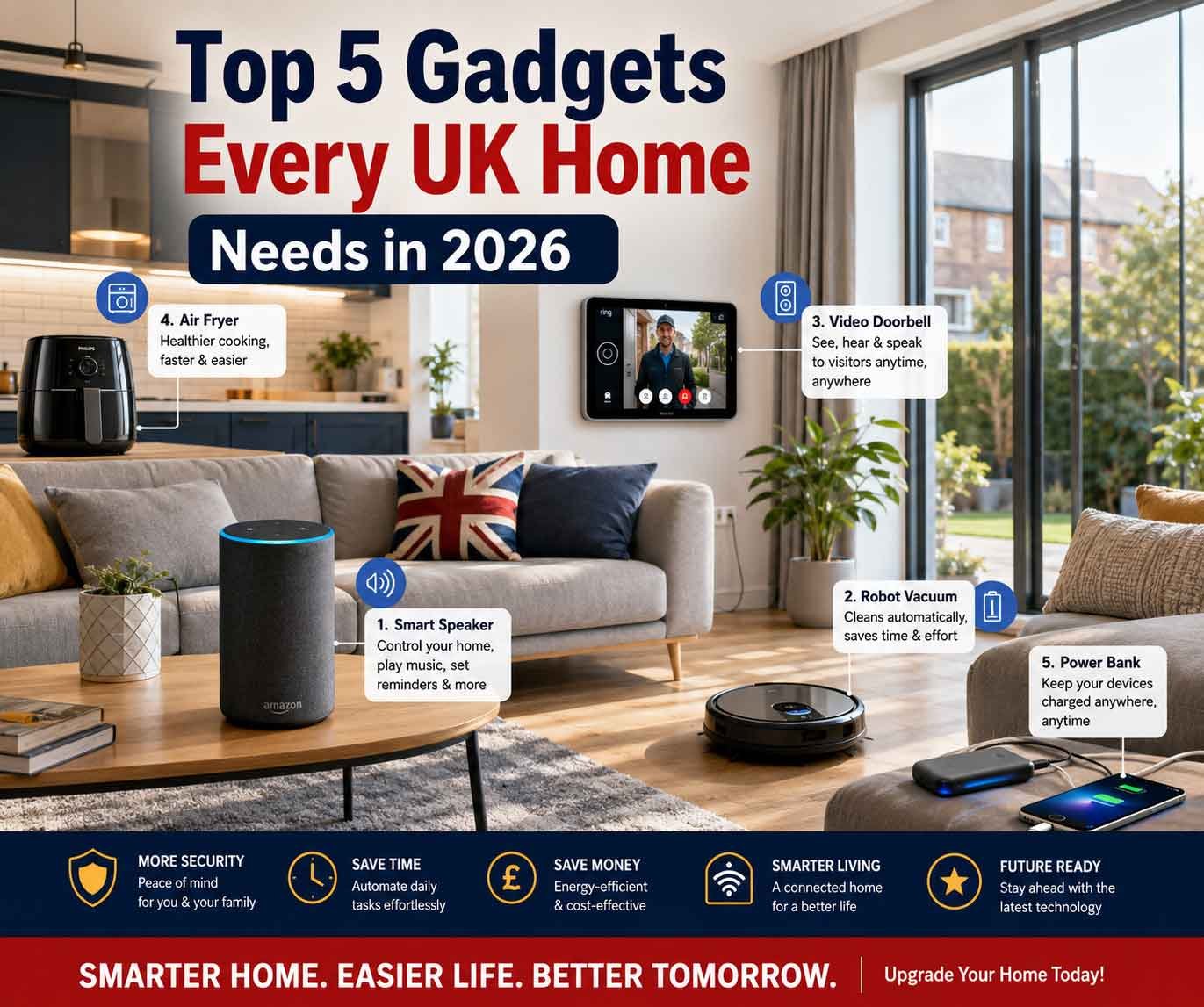
Top 5 Gadgets Every UK Home Needs in 2026
Is Your Home Ready for 2026?
Picture this. It is a grey Tuesday morning in Manchester. You have overslept by twenty minutes. The kids need breakfast, the dog needs walking, and you cannot find your keys. Meanwhile, across the street, your neighbour walks out of their front door looking impossibly calm, coffee in hand, with their robot vacuum already working on the living room floor, their smart doorbell confirming the postman has already been, and their air fryer prepping lunch for later in the day — all without lifting a finger.
That is not a fantasy. That is what a genuinely smart UK home looks like in 2026.
The British household has undergone a quiet revolution. According to Statista, the UK smart home market was valued at over £5.4 billion in 2024 and is projected to surpass £8 billion by 2027. British consumers are no longer content with clever gadgets as novelties. They want technology that genuinely reduces effort, saves money on energy bills, and improves quality of life. And in 2026, the five gadgets covered in this article deliver exactly that.
Whether you are a first-time tech buyer or a seasoned home automation enthusiast, this guide cuts through the noise and tells you precisely which home gadgets are worth your money right now. These are not gimmicks. These are the devices that are reshaping how UK families live, work, and relax — and they are more affordable, more powerful, and more essential than ever before.
Read on. Your home is about to get a serious upgrade.
- The UK smart home market is growing rapidly, making 2026 the ideal time to invest in home technology.
- Smart speakers with AI integration are the central hub of the modern UK smart home.
- Robot vacuums now use laser mapping and AI to clean more intelligently than ever before.
- Video doorbells have become a home security standard for UK households, with significant crime deterrence data behind them.
- Air fryers remain the most-used kitchen gadget in Britain, combining speed, health, and energy efficiency.
- Portable power banks with multi-device and wireless charging are indispensable for modern mobile lifestyles.
- All five gadgets on this list offer genuine, measurable value — not just convenience.
Why 2026 Is the Defining Year for UK Home Technology
The term “smart home” has been thrown around since at least 2015. For much of that decade, it meant overpriced, unreliable devices that required an IT degree to set up and a separate app for every single function. British consumers, pragmatic by nature, were largely unconvinced.
That era is over.
In 2026, home gadgets for UK households have reached a tipping point of maturity. Prices have dropped dramatically. Interoperability between devices — meaning your smart speaker can talk to your robot vacuum which can talk to your doorbell — has become the norm rather than the exception. The Matter smart home standard, fully adopted by major manufacturers by 2025, means that most premium devices now work together seamlessly regardless of brand.
Energy costs remain a major concern for UK households following years of volatility in the energy market. The Office for National Statistics confirmed that energy expenditure remains one of the top three household concerns for British families. Crucially, the right home gadgets — particularly the five listed here — directly address that concern. Energy-saving home gadgets UK are no longer a niche category; they are mainstream purchases driven by genuine financial motivation.
There is also the generational shift to consider. Millennials are now firmly in the property-owning demographic, and Gen Z renters are the most tech-comfortable generation ever measured. Both groups expect their living spaces to work with them, not against them. The home gadget market has responded accordingly, producing devices that are intuitive, stylish, and built for real British homes — not just Silicon Valley showrooms.
Finally, there is the post-pandemic home investment trend that has never entirely reversed. The British public spent record amounts on home improvement between 2020 and 2023, and a significant portion of that spending went into home technology. That habit has stuck. A 2026 UK home tech guide written without acknowledging this cultural shift would miss the entire context of why these gadgets matter.
1. Smart Speakers with AI Integration — The Brain of Your UK Smart Home
Why Smart Speakers Are No Longer Optional
If a smart home has a brain, it is the smart speaker. In 2026, smart speakers have evolved well beyond playing music and answering trivia questions. The latest generation — led by devices like the Amazon Echo Hub, Google Nest Audio Pro, and Apple HomePod 3 — are genuinely intelligent home management centres powered by large language models that understand natural, conversational requests.
Ask your smart speaker to “dim the living room lights to 40 percent, lock the front door, and set an alarm for 7am” and it will handle all three simultaneously. Ask it whether you remembered to turn off the oven, and it will check your connected appliances and confirm. Ask it to find a chicken tikka masala recipe scaled for six people and it will read it to you step by step while you cook, pausing when you ask it to.
This is the best smart speaker for UK homes in 2026: not a novelty device, but a practical assistant that saves time every single day.
What to Look for When Buying a Smart Speaker in the UK
When choosing a smart speaker for UK homes, there are several factors that matter specifically for British households. First, ensure the device has a strong UK English voice recognition track record. Early smart speakers genuinely struggled with regional British accents — Glaswegian, Geordie, and Brummie speakers were frequently misunderstood. The 2025 and 2026 models have largely resolved this with improved accent-adaptive AI, but it is worth checking reviews from UK-based users specifically.
Second, consider Matter compatibility. Any smart speaker you buy in 2026 should support the Matter standard so it can communicate with other smart home devices regardless of manufacturer. This is non-negotiable if you plan to expand your smart home setup over time.
Third, think about privacy. The Information Commissioner’s Office in the UK has issued updated guidance on smart speaker data practices. Choose devices from manufacturers with clear, GDPR-compliant data policies and the option to review and delete your voice history.
Top pick for 2026: The Amazon Echo Hub offers a touchscreen display combined with a full Alexa AI assistant, Matter support, and Zigbee connectivity for around £179 — making it the most capable smart home hub in its price range for UK buyers.
Statista data from 2025 indicates that over 32 percent of UK households now own at least one smart speaker, and that figure is rising sharply among homeowners aged 25 to 44. The smart home devices UK 2026 category is being driven significantly by this product type.
2. Robot Vacuum Cleaners — Reclaim Hours of Your Week
The Robot Vacuum Revolution Has Matured
Few home gadgets have improved as dramatically in five years as the robot vacuum. The early models were frustrating: they got stuck on rugs, missed corners, needed constant supervision, and had to be manually emptied every three rooms. The 2026 models are a different category entirely.
Modern robot vacuums for UK homes use LiDAR laser mapping and AI-powered obstacle recognition to clean intelligently. They create precise floor maps of your home, remember room layouts, avoid cables and pet toys, empty themselves into a base station that holds weeks of debris, and can be instructed by room, by schedule, or on demand via your smart speaker or app.
For British households with pets — and the PDSA estimates over 17 million UK households own at least one pet — a robot vacuum is arguably the single highest-return home gadget investment available. Dog and cat hair on carpets and hard floors is a daily battle, and a robot vacuum running on a morning schedule removes that battle entirely.
Best Robot Vacuums Available in the UK Right Now
The market leaders for best robot vacuum UK 2026 are the Roborock S8 Pro Ultra, the Dyson 360 Vis Nav, and the Ecovacs Deebot X2 Omni. Each offers self-emptying, self-cleaning mop functionality, and room-specific cleaning routines.
The Dyson 360 Vis Nav is particularly well-suited to British homes, which statistically have more carpeted rooms than EU counterparts. Its unique 360-degree camera vision system and Dyson’s established suction reputation make it a premium but justified choice.
For budget-conscious buyers, the Dreame D10 Plus offers LiDAR mapping, automatic emptying, and strong suction performance at under £350 — making it the best budget robot vacuum in the UK for households not ready to spend £700 or more.
Key practical insight: schedule your robot vacuum to run while you are at work or on the school run. When you return home, the floors are clean without any effort on your part. Over a typical week, UK households spend an estimated 4.2 hours on floor cleaning tasks according to Mintel consumer data. A robot vacuum returns the vast majority of that time.
Energy consumption is another benefit worth noting. Premium robot vacuums use between 25 and 40 watts during operation — significantly less than a conventional corded vacuum’s 1,000 to 2,500 watts — which matters directly to UK energy bills.
3. Video Doorbells — The UK’s Most Trusted Home Security Gadget
Why Video Doorbells Have Become a UK Home Essential
Walk down almost any residential street in a British city today and you will notice how many homes now have a video doorbell mounted beside the front door. This is not coincidence. It is a rational response to real security concerns combined with genuine practical value.
UK Finance data from 2024 confirmed that doorbell camera footage has been cited as contributory evidence in over 30,000 insurance claims and criminal investigations across the UK in a two-year period. The deterrence effect is also well documented: academic research published by the Suzy Lamplugh Trust found that visible security cameras at the point of entry reduce opportunistic burglary attempts by a statistically significant margin.
But security is only part of the story. For UK households, the best video doorbell 2026 is a daily convenience tool. It lets you see and speak to delivery drivers when you are not home, so you can redirect parcels rather than returning to a failed delivery card. It logs who arrives and when. It lets elderly relatives or children communicate with whoever is at the door without opening it. It integrates with your smart speaker so you get an audio alert inside the house when someone approaches.
Choosing the Right Video Doorbell for a British Home
There are specific considerations for UK homes that differentiate the buying decision from North American market advice, which dominates online reviews. UK properties often have older wiring, narrower door frames, and specific planning considerations regarding camera angles and neighbour privacy — the latter being a genuine legal concern under UK law and the GDPR.
The Ring Video Doorbell 4 and the Arlo Essential Video Doorbell Wire-Free are among the top-rated video doorbells in the UK because both offer battery-powered options that avoid the need for existing doorbell wiring, both have privacy zone settings to comply with UK neighbour privacy guidance, and both integrate with Amazon Alexa and Google Home ecosystems respectively.
For households seeking the most advanced smart video doorbell with AI detection UK, the Ring Doorbell Pro 2 uses Bird’s Eye View aerial mapping and 3D motion detection to distinguish between people, vehicles, and animals — a meaningful upgrade from earlier generation motion alerts that triggered on every passing car.
Installation is genuinely achievable as a DIY project in an afternoon for most UK homeowners, with no specialist electrical knowledge required for the battery-powered models.
4. Air Fryers — Britain’s Favourite Kitchen Gadget Gets Even Smarter
The Air Fryer Phenomenon: Why Every UK Kitchen Has One
No home gadget in recent British history has achieved cultural saturation as quickly and completely as the air fryer. According to Which? consumer research, over 50 percent of UK households now own an air fryer — a figure that has more than doubled since 2021. It has become, alongside the kettle, one of the defining British kitchen appliances of its generation.
The reasons are not complicated. Air fryers cook faster than conventional ovens, use up to 75 percent less energy according to independent testing by the Energy Saving Trust, produce crispier results than microwave reheating, and require minimal oil — making them genuinely healthier for everyday cooking. During the period of UK energy price instability, thousands of households switched from oven cooking to air fryer cooking specifically to reduce electricity bills, and most of them have not switched back.
In 2026, smart air fryers for UK kitchens have added a new dimension: connectivity. The newest models from Ninja, Cosori, and Instant offer Wi-Fi connectivity, app-controlled cooking programmes, voice assistant integration, and guided cooking modes that walk you through recipes step by step with automatic temperature and time adjustments.
The Best Air Fryers for UK Homes in 2026
For most UK households, the Ninja Double Stack XL remains the top recommendation. Its dual-basket design allows two different foods to be cooked at different temperatures simultaneously, finishing at the same time — a genuinely useful feature for families preparing multiple dishes. It has a 9.5-litre capacity suitable for a family of four, voice assistant compatibility, and a library of guided recipes.
The Cosori Dual Blaze is a strong alternative for households prioritising smart features, offering precise temperature control to within one degree, a companion app with 100-plus recipes, and compatibility with Alexa and Google Assistant.
For those with smaller kitchens or single-person households, the Instant Vortex 4-in-1 delivers excellent results at a compact size and price point under £70, making it the best affordable air fryer in the UK.
Practical insight worth knowing: air fryers are not just for chips and frozen food, though they do both superbly. They roast vegetables, bake small cakes, reheat pizza to a genuinely crispy finish, cook fish perfectly in under ten minutes, and produce restaurant-quality chicken wings in twenty minutes. For UK households trying to reduce takeaway spending, a quality air fryer pays for itself in weeks.
The energy-efficient cooking appliances UK 2026 category is dominated by air fryers for good reason: the combination of speed, quality results, and low energy draw is unmatched by any other cooking method at this price point.
5. Portable Power Banks with Wireless Charging — Never Be Without Power Again
Why Portable Power Banks Are a 2026 Essential
Portable power banks might seem less glamorous than robot vacuums or smart speakers, but make no mistake: in 2026, a high-quality portable power bank is as essential as a house key for most UK adults. Smartphones are no longer communication tools — they are navigation devices, payment terminals, boarding passes, identity verification tools, and work computers. Running out of battery is not an inconvenience; it is a genuine problem.
The 2026 generation of portable power banks UK has undergone a transformation that makes earlier models look primitive. The best current devices offer 20,000mAh+ capacity, simultaneous wireless charging for multiple devices, 65-watt USB-C Power Delivery output capable of charging a laptop, MagSafe-compatible wireless pads for iPhone users, and compact form factors that fit in a jacket pocket.
Anker, Belkin, and Zendure are the leading brands for best portable power bank UK 2026, with each offering products that address different household and lifestyle needs.
What to Look for in a UK Portable Power Bank in 2026
Capacity matters, but it is not the only factor. A 20,000mAh power bank sounds impressive, but if it only outputs at 10 watts, it will take six or seven hours to charge a modern iPhone 16. Look for models with at least 30-watt USB-C output for smartphones and 65-watt output if you intend to charge a laptop or tablet.
The Anker Prime 20,000mAh is the standout recommendation for UK buyers who want the best overall performance. It offers 200-watt total output, wireless charging, and a companion app that monitors battery health — remarkable capabilities in a device smaller than a paperback book.
For households with multiple Apple devices, the Belkin BoostCharge Pro 3-in-1 serves as both a home wireless charging station and a portable option, charging iPhone, AirPods, and Apple Watch simultaneously — making it one of the most practical Apple device charging solutions UK available.
Budget-conscious buyers should consider the Anker 523 Power Bank at under £35, which delivers 20,000mAh and 25-watt USB-C output in a slim, lightweight form factor suited to daily commuting.
One overlooked use case that is particularly relevant to UK families: power banks as home backup power during brief power cuts. With the National Grid’s reported increase in short-duration outages in certain regions, having a charged 20,000mAh power bank means your phone, smart home hub, and essential devices remain operational even during a temporary outage.
How These 5 Gadgets Work Together as a UK Smart Home Ecosystem
The real magic of these five gadgets is not any single device — it is how they interact as a system. In a well-configured UK smart home in 2026, this is what a typical day might look like.
Your smart speaker wakes you with a personalised briefing at 7am — weather, calendar, and whether any parcels are scheduled for delivery. Your robot vacuum has already run its morning programme while you slept, triggered automatically at 6am. The video doorbell pings your phone and announces through the smart speaker when the Amazon delivery arrives at 9am. Your air fryer, connected to your smart speaker, starts preheating for lunch at 11:45am when you ask it to. And your power bank, charged overnight via a bedside dock, leaves with you fully powered for the day ahead.
This is not a futuristic vision. This is a practical, achievable, affordable smart home reality for UK households right now.
The total cost of all five devices, choosing the recommended mainstream options rather than premium alternatives, comes to approximately £700 to £900 — a one-time investment that delivers daily value, reduces household chores, lowers energy bills, and improves home security year after year.
Frequently Asked Questions (FAQs)
1. What are the best home gadgets for UK homes in 2026?
The top five are smart speakers with AI integration, robot vacuum cleaners with self-emptying bases, video doorbells with motion detection, smart air fryers with app connectivity, and high-capacity portable power banks with wireless charging. Each delivers genuine daily value for British households.
2. Are robot vacuums worth buying for UK homes with carpets?
Yes. The 2026 generation of robot vacuums, particularly the Dyson 360 Vis Nav and Roborock S8 Pro Ultra, are specifically engineered for high-pile carpets common in UK homes. They deliver strong suction alongside hard floor mopping capability.
3. Which video doorbell is best for UK homes in 2026?
The Ring Video Doorbell Pro 2 is the top premium choice, while the Ring Video Doorbell 4 and Arlo Essential offer excellent value. All three are compatible with UK wiring requirements and privacy zone settings to comply with GDPR guidance on neighbour privacy.
4. Do air fryers actually save money on UK energy bills?
Yes, substantially. The Energy Saving Trust has confirmed that air fryers use up to 75 percent less electricity than a conventional oven for equivalent cooking tasks. For families cooking daily, the annual saving can range from £80 to £200 depending on usage patterns.
5. What is the best smart speaker for UK homes right now?
The Amazon Echo Hub (with built-in touchscreen and Alexa AI) and the Google Nest Audio are the leading choices for most UK homes in 2026. Both support the Matter standard for smart home interoperability and have strong UK English accent recognition.
6. How do I choose a portable power bank for everyday UK use?
Look for at least 20,000mAh capacity, USB-C Power Delivery output of 30W or above, and wireless charging capability if you use a Qi-compatible device. The Anker Prime 20,000mAh is the best overall option for UK buyers seeking premium performance.
7. Are smart home gadgets safe from a UK data privacy perspective?
Smart home devices from major manufacturers are required to comply with UK GDPR. Amazon, Google, and Apple all offer transparency tools for reviewing voice and activity data. Using devices on a separate IoT Wi-Fi network adds an additional layer of security, which is recommended by the National Cyber Security Centre (NCSC).
8. Can a video doorbell work without an existing doorbell wiring in a UK home?
Yes. Battery-powered models like the Ring Video Doorbell 4 and Arlo Essential require no existing wiring and can be installed as a DIY project in under an hour using standard UK fixings.
9. What smart home gadgets are best for UK families with young children?
Smart speakers for whole-home audio and timers, video doorbells for front door visibility without opening the door, and air fryers for quick healthy meals are particularly well suited to family households. Robot vacuums also provide significant daily value for families dealing with mess and pet hair.
10. What is the most popular home gadget in the UK right now?
According to Which? consumer research, the air fryer is the most widely owned kitchen gadget in UK homes as of 2025, with over half of all households owning one. Smart speakers follow closely, with robot vacuum ownership growing the fastest year-on-year.
Conclusion: Future-Proof Your UK Home Starting Today
The homes that work best in 2026 are not the ones with the most gadgets. They are the ones with the right gadgets, thoughtfully chosen and working together as a coherent system.
Smart speakers that act as household command centres. Robot vacuums that clean without being asked. Video doorbells that protect and inform. Air fryers that cook faster, healthier, and cheaper. Portable power banks that keep modern life moving. These five products represent the intersection of proven technology, genuine UK household need, and exceptional value for money.
The British consumer has always demanded practicality before novelty, and the 2026 home gadget market has finally caught up. These are not gadgets for gadget lovers. These are tools for everyone.
If you are starting your smart home journey, begin with a smart speaker — it is the connective tissue everything else plugs into. If you already have one, a robot vacuum or a video doorbell will deliver the most noticeable daily improvement to your life.
Share this article with someone who is still vacuuming their own floors, waiting by the door for deliveries, or cooking pasta on a gas hob when an air fryer could do the job in eight minutes. They will thank you.
And when you make your first purchase from this list, come back and tell us which one changed your home the most. The conversation is just getting started.