
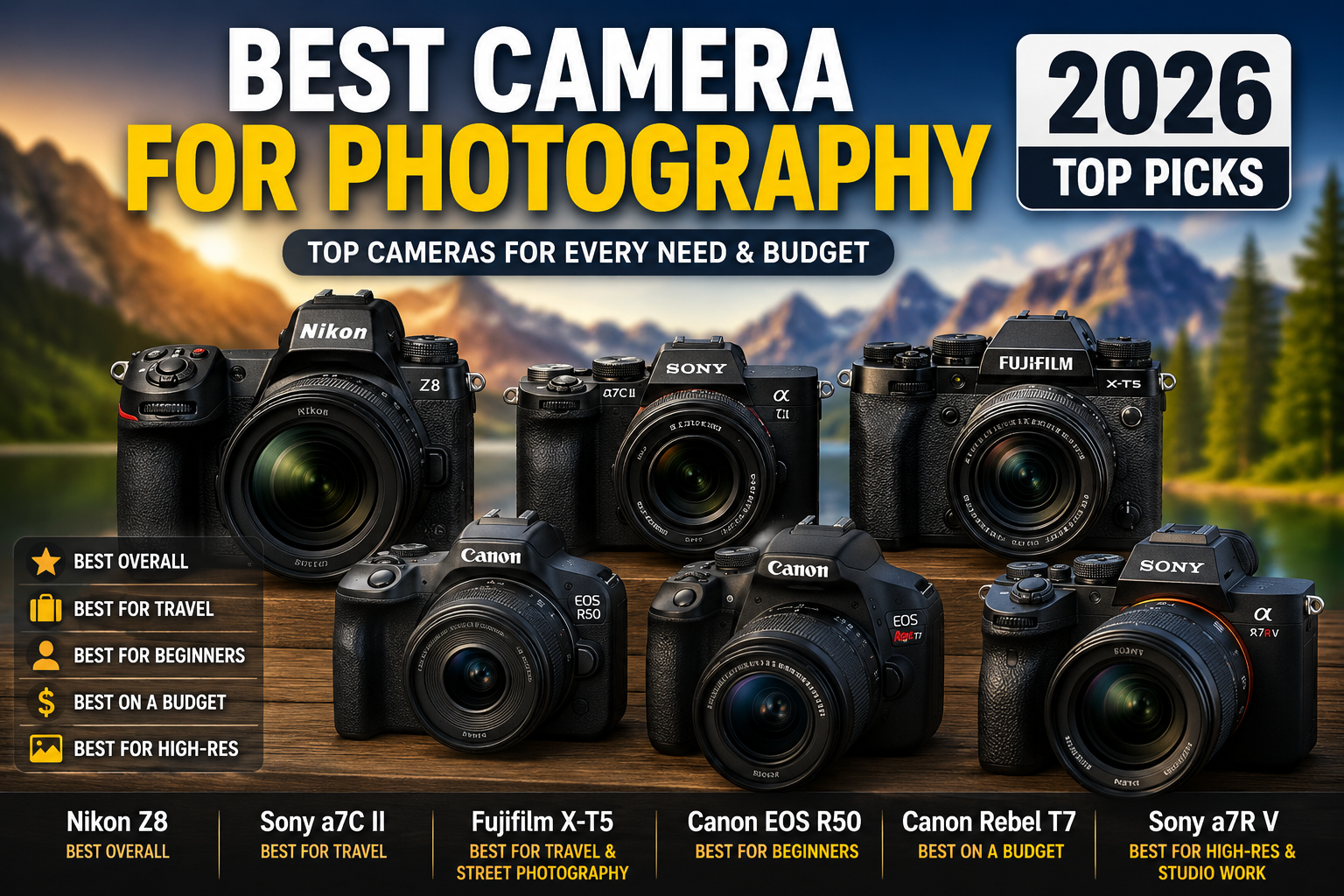
Best Camera for Photography in 2026: Top Picks for Every Photographer
Photography has changed dramatically over the past few years. Smartphone cameras continue to improve, artificial intelligence is transforming image processing, and camera manufacturers are pushing the limits of sensor technology. Yet one question remains constant: what is the best camera for photography?
The answer may surprise you. There is no single camera that is perfect for everyone. The ideal camera depends on your budget, skill level, photography style, and future goals. A travel photographer may prioritize portability, while a landscape photographer demands extreme resolution. Beginners often seek simplicity, whereas professionals require cutting-edge autofocus and performance.
In 2026, photographers have access to some of the most advanced cameras ever created. From flagship full-frame mirrorless models to budget-friendly beginner cameras, there is an option for every creator. This guide explores the best cameras for photography in 2026, helping you choose the perfect camera for your needs.
If you have typed “best camera for photography 2025” into a search engine recently, you already know the problem: the results are overwhelming, contradictory, and often written by people trying to sell you something. The truth is simpler than most buying guides admit — there is no single best camera for everyone. The right camera is the one that matches your skill level, your shooting style, your budget, and what you actually plan to photograph.
1. Best Overall Camera for Photography in 2025: Nikon Z8
Best for: Professional photographers, serious enthusiasts, wedding photography, wildlife, sports, and events
Price range: ~$3,999 body only
If you want the single best all-around camera you can buy in 2025, most professional photographers will point you toward the Nikon Z8. It is not just a great camera — it is a statement about what modern mirrorless technology can achieve.
What Makes the Nikon Z8 Special
The Nikon Z8 was engineered to deliver the full feature set of Nikon’s flagship Z9 — widely considered the most capable professional camera on the market — in a body that is meaningfully smaller and lighter. That is an extraordinary engineering achievement, and it changes how photographers work.
At the heart of the Z8 is a 45.7-megapixel full-frame stacked BSI CMOS sensor. The “stacked” design is critical: unlike traditional sensors, a stacked sensor processes data at dramatically faster speeds, which is what enables the Z8’s blackout-free shooting, its blistering burst rate, and its ability to shoot completely silent without any rolling shutter distortion. That last point matters enormously for wedding photographers and photojournalists who cannot afford the click of a shutter in a quiet ceremony or courtroom.
Autofocus That Actually Works
Autofocus is often the deciding factor for action photographers, and the Z8 delivers elite performance. Its subject-detection system can identify and lock onto human eyes, faces, animals, birds, vehicles, and aircraft in real time. Even in challenging lighting conditions — backlit subjects, fast movement, unpredictable behavior — the Z8 tracks with a reliability that was previously available only on cameras costing significantly more.
For dog sport photographers, bird photographers, and anyone shooting fast-moving subjects, the Z8’s autofocus is genuinely transformative.
Video Capabilities
The Nikon Z8 is also a serious video tool, capable of shooting 8K RAW internally — a specification that was unheard of at this price point just a few years ago. It records 4K at up to 120 frames per second, making it capable of slow-motion footage at a quality level that rivals dedicated cinema cameras.
Why Professionals Choose the Nikon Z8
- Equivalent performance to the Nikon Z9 at a lower price
- Compact enough for all-day handheld shooting
- Compatible with the full Nikon Z lens ecosystem
- No mechanical shutter means silent operation anywhere
- Dual card slots (CFexpress and SD) for backup redundancy
The verdict: For professionals and advanced enthusiasts who want one camera that can do everything without compromise, the Nikon Z8 is the answer in 2025. It is the best mirrorless camera for wedding photography, the best camera for wildlife photography, and one of the best cameras for portrait photography — all in one body.
2. Best Camera for Travel Photography in 2025 {#travel}
Travel photography presents a unique challenge: you need image quality good enough to do your destinations justice, but portability matters just as much as performance. Carrying a heavy camera bag through airports, cobblestone streets, and mountain trails is miserable. Two cameras stand out as the best options in 2025, and they represent meaningfully different philosophies.
Sony a7C II — Best Full-Frame Travel Camera
Best for: Travelers who prioritize low-light performance, video, and discreet shooting
Price range: ~$2,199 body only
The Sony a7C II holds a remarkable distinction: it is the smallest and lightest full-frame mirrorless camera currently available. That matters because full-frame sensors produce dramatically better image quality — especially in low light — than the smaller APS-C sensors found in most compact cameras.
Why the Sony a7C II Is Perfect for Travel
When you travel, you often shoot at dawn, dusk, inside dimly lit restaurants, under the artificial glow of night markets, or in the shadowed interiors of ancient buildings. These are exactly the conditions where full-frame sensors shine. The a7C II’s sensor captures more light per pixel, which translates to cleaner images with less noise at high ISO settings.
The camera also inherits Sony’s latest AI-based autofocus system — the same technology found in Sony’s professional Alpha 9 series. It tracks human eyes, animals, and moving subjects with a consistency that makes it an excellent travel camera for street photography, where subjects move unpredictably and you rarely have time to manually focus.
Key specifications:
- 33-megapixel full-frame BSI CMOS sensor
- ISO range expandable to 204,800
- 10 frames per second continuous shooting
- 5-axis in-body image stabilization (up to 7 stops)
- 4K video at up to 60fps
- Weighs just 514g with battery and card
The a7C II’s in-body image stabilization (IBIS) deserves special mention for travelers. When you are photographing hand-held from a moving boat, a bus, or simply tired after a long day of walking, IBIS compensates for camera shake and allows you to shoot at slower shutter speeds without blur. This is the kind of feature that saves shots you would otherwise have lost.
The verdict for travelers: If you want full-frame image quality in a body that fits in a small shoulder bag — and particularly if you shoot in low light or need excellent video — the Sony a7C II is the best travel camera you can buy.
Fujifilm X-T5 — Best APS-C Travel Camera
Best for: Travelers who love manual control, street photography, and Fujifilm’s legendary film simulations
Price range: ~$1,699 body only
Where the Sony a7C II is a triumph of miniaturization and modern technology, the Fujifilm X-T5 is something altogether more personal. It is a camera with a philosophy — one that believes photography should be a tactile, deliberate, joyful practice.
The Fujifilm Experience
Pick up the X-T5 and you immediately notice the physical dials on the top plate: one for shutter speed, one for ISO, one for exposure compensation. These are not menu items buried three screens deep. They are physical controls that you can adjust without taking your eye from the viewfinder. For photographers who shoot with intention rather than in burst mode, this approach fundamentally changes the creative experience.
The X-T5 is built around a 40.2-megapixel APS-C sensor — the highest resolution in any APS-C mirrorless camera. That is a remarkable figure. In practical terms, it means you can crop aggressively without losing detail, which is enormously useful in street photography when you cannot always get physically close to your subject.
Fujifilm Film Simulations
Fujifilm’s film simulations are the camera’s secret weapon. These are not Instagram filters applied after the fact — they are precisely engineered color science profiles that replicate the look of classic Fujifilm photographic films: Velvia for vivid landscapes, Classic Chrome for muted editorial tones, Provia for faithful color reproduction. Many Fujifilm photographers shoot JPEG exclusively because the out-of-camera files are simply beautiful.
Key specifications:
- 40.2-megapixel APS-C X-Trans CMOS 5 HR sensor
- Up to 20 frames per second electronic shutter
- 7-stop in-body image stabilization
- 6.2K video recording
- Compact, weather-sealed body
- Physical aperture, shutter, and ISO dials
The verdict for travelers: If you are a photographer who values the shooting experience as much as the technical output — and especially if you are drawn to street photography, documentary work, or simply enjoy manual control — the Fujifilm X-T5 is one of the most rewarding cameras you will ever use.
3. Best Camera for Beginners in 2025: Canon EOS R50
Best for: Smartphone upgraders, first-time DSLR or mirrorless buyers, vloggers, and students learning photography
Price range: ~$699 body only / ~$899 with kit lens
Learning photography is an investment of time and attention. The last thing you need is a camera that makes the learning curve steeper by being unnecessarily complicated or frustratingly slow. The Canon EOS R50 was designed with exactly this in mind, and it is the best beginner camera available in 2025 by a comfortable margin.
Why the Canon EOS R50 Is Perfect for Beginners
The R50 strikes an exceptional balance: it is simple enough that a complete beginner can pick it up and start taking good photos immediately, but it is technically capable enough that you will not outgrow it for years.
Image Quality That Surprises
The R50’s 24.2-megapixel APS-C sensor produces files that are genuinely excellent — sharp, detailed, with pleasing color reproduction straight from the camera. For most people upgrading from a smartphone, the quality jump will feel revelatory. Even in moderately low light, the R50 handles itself well, and the kit lens (18-45mm) is good enough to learn on without immediately feeling the urge to upgrade.
Autofocus That Does the Hard Work for You
One of the biggest frustrations for beginners is missed focus — you captured the moment, but the camera focused on the background instead of your subject. The R50 solves this with Canon’s Dual Pixel CMOS AF II system, which uses AI to detect and track human faces, eyes, and bodies in real time. Point the camera at a person and it locks onto their eye automatically. For family photography, portraits, and street photography, this is transformative.
The burst shooting rate of 15 frames per second means that for fast-moving subjects — children playing, pets running, sports — you simply hold the button down and choose the best frame later.
Easy to Learn, But Teaches You Well
Canon’s menu system is among the most intuitive in the industry. The R50 includes a guided interface mode that explains what each setting does as you adjust it — genuinely useful for someone who is learning the relationship between aperture, shutter speed, and ISO for the first time. As you grow, you can switch to more manual control modes without needing a new camera.
Key specifications:
- 24.2-megapixel APS-C CMOS sensor
- 15 fps continuous shooting (electronic shutter)
- Full subject tracking autofocus (faces, eyes, bodies, animals)
- 4K video recording (oversampled from 6K)
- Lightweight at just 375g body only
- Compatible with Canon’s RF lens ecosystem
The verdict for beginners: The Canon EOS R50 is the best beginner mirrorless camera of 2025. It is fast, easy to use, produces beautiful images, and grows with you as your skills develop. Pair it with the kit lens and a 50mm prime lens, and you have everything you need to learn photography properly.
4. Best Budget Camera for Photography in 2025: Canon EOS Rebel T7 / T8i
Best for: Budget-conscious beginners, students, hobbyists who want to learn on a classic platform
Price range: T7 from ~$399 / T8i from ~$649 (body only; significant savings when bought used)
Not everyone can or should spend $700 on their first camera. The Canon EOS Rebel series — specifically the T7 and its newer sibling the T8i — remains the world’s best-selling entry-level camera line for a reason that has nothing to do with marketing: it is excellent value.
Why the Canon Rebel T7 / T8i Still Makes Sense in 2025
In an era of mirrorless cameras, a DSLR recommendation might seem like an odd choice. But for photographers on a tight budget, the Canon Rebel series has one enormous advantage: the Canon EF lens ecosystem.
Canon has been making EF-mount lenses since 1987. There are hundreds of them, ranging from affordable kit lenses to professional-grade glass, and because the system is so mature, used lenses are widely available at very low prices. A used Canon 50mm f/1.8 — one of the sharpest, most versatile lenses available for any system — can be found for under $80. A used 70-200mm telephoto, which would cost over $2,000 new in a mirrorless system, can often be found used for a fraction of the price.
This lens ecosystem advantage cannot be overstated for beginners on a budget. The camera body is just one part of a photography system, and the Canon Rebel gives you access to the deepest, most affordable lens catalog in the world.
Learning Photography on a Canon Rebel
The Canon Rebel T7 and T8i share the same core layout that Canon has refined over decades. The controls are intuitive, the menu is straightforward, and the optical viewfinder gives you a direct, real-time view of your scene without any electronic processing — something many photographers prefer when learning to compose images.
The T8i adds meaningful improvements over the T7: a higher resolution 24.1-megapixel sensor (vs 24.1MP on the T7 as well, but with improved processing), faster burst shooting, better autofocus, and a fully articulating touchscreen useful for video and awkward shooting angles.
Key specifications (T8i):
- 24.1-megapixel APS-C CMOS sensor
- ISO 100-25,600 (expandable to 51,200)
- 7 fps continuous shooting
- Dual Pixel CMOS AF (T8i) / 9-point AF (T7)
- 4K video (T8i) / 1080p (T7)
- Optical viewfinder
- Compatible with entire Canon EF lens ecosystem
The verdict for budget buyers: If you want to learn photography without spending a fortune, the Canon Rebel T7 or T8i is still the smartest choice in 2025. Buy the T7 body used for under $300, pick up a used 50mm f/1.8 lens for $70, and you have a complete photography education kit for less than $400 total. Few investments in creative education pay off as quickly.
5. Best High-Resolution Camera for Studio & Landscape Photography: Sony Alpha 7R V
Best for: Commercial photographers, landscape photographers, architecture photographers, fine art printing, studio work
Price range: ~$3,499 body only
Resolution is not everything in photography — but when you need it, nothing else will do. The Sony Alpha 7R V is the definitive answer for photographers who demand maximum detail: the ability to crop extensively, the capacity to print large, and the confidence that every fine texture and subtle gradation is being captured.
61 Megapixels: What It Actually Means in Practice
The 7R V’s 61-megapixel full-frame BSI CMOS sensor produces images that are 9,504 × 6,336 pixels. At that resolution, you can print a single image at 24 × 36 inches at full 300 DPI — the standard for fine art and commercial printing — with nothing left to spare. You can crop 70% of a landscape image and still have a printable file. For commercial photographers delivering assets that will be used across a range of sizes and formats, this kind of resolution gives you flexibility that lower-resolution cameras simply cannot match.
In landscape photography, extreme resolution reveals details that are invisible at 24 or 33 megapixels: individual leaves on distant trees, the texture of rock faces, the subtle gradations in a dawn sky. These are the details that make a large print feel like a window rather than a photograph.
AI-Driven Autofocus in a High-Resolution Camera
High-resolution cameras traditionally sacrificed autofocus speed for resolution — the sheer amount of data being processed made fast tracking difficult. Sony has solved this with the Alpha 7R V’s AI-based autofocus system, which uses a dedicated AI processing chip separate from the main image processor.
The result is autofocus performance that rivals Sony’s sports-focused cameras, despite the enormous file sizes involved. The system tracks human poses, recognizes animals and birds, and locks onto subjects with a reliability that was unimaginable in high-resolution cameras five years ago. For photographers who need both resolution and accurate autofocus — portrait photographers, fashion photographers, anyone photographing people against complex backgrounds — the 7R V resolves a tension that previously required compromising on one or the other.
Pixel Shift Multi-Shooting
For studio photographers in controlled environments, the 7R V offers a Pixel Shift Multi-Shooting mode that composites multiple frames into a single image with effectively 241 megapixels of detail. This is used in museum and archive photography, ultra-high-resolution product photography, and art reproduction — situations where absolute fidelity to the subject is the primary goal.
Key specifications:
- 61-megapixel full-frame BSI CMOS sensor
- AI-based subject recognition (human, animal, bird, insect, car, train, aircraft)
- 10 fps continuous shooting
- 8K timelapse recording
- 5-axis in-body stabilization (up to 8 stops)
- Pixel Shift Multi-Shooting (up to 241MP composite)
- Dual card slots (CFexpress A and SD)
The verdict for high-resolution work: If your photography demands the maximum possible detail — whether for large-format printing, commercial deliverables, or exacting landscape work — the Sony Alpha 7R V is the best camera available at any price for resolution-critical photography. It is a specialist tool for a specific kind of photographer, and for that photographer, it is unrivaled.
How to Choose the Right Camera for You in 2025
With so many options available, the decision comes down to five honest questions:
Question 1: What will you actually photograph?
This is the most important question. Fast-moving subjects — sports, wildlife, children — demand fast autofocus and burst shooting. Landscapes and studio work reward resolution. Travel photography rewards portability. Portrait work demands good skin tone rendering and reliable face-detection autofocus. Write down the three things you photograph most, and let that guide your choice.
Question 2: What is your real budget — including lenses?
Camera bodies get most of the attention, but lenses are often the more important investment. A modest body with excellent glass will almost always outperform an expensive body with a mediocre kit lens. Budget at least as much for lenses as for the body, and factor in the cost and availability of lenses in the system you choose.
Question 3: Full-frame or APS-C?
Full-frame sensors produce better low-light performance, shallower depth of field for portraits, and generally higher image quality — but they are heavier, larger, and more expensive. APS-C sensors are lighter, cheaper, and excellent for travel and everyday use. Unless you regularly shoot in challenging low light or need the absolute best quality, APS-C is a perfectly capable choice in 2025.
Question 4: Mirrorless or DSLR?
For anyone buying new in 2025, mirrorless is almost always the right answer. Mirrorless cameras have caught up with and in many cases surpassed DSLRs in autofocus performance, and they offer features — silent shooting, real-time exposure preview, face and eye detection — that DSLRs simply cannot match. The only compelling reason to choose a DSLR in 2025 is the Canon Rebel for budget-conscious buyers, where the vast used lens ecosystem changes the value equation.
Question 5: What system will you grow into?
Your camera body will probably be replaced in five years. Your lenses might last thirty. Before committing to a camera, research the lens ecosystem: how many lenses are available, at what price points, and how the system is likely to develop. Sony, Canon, and Nikon all have strong, growing mirrorless ecosystems. Fujifilm’s APS-C system is excellent and well-supported. Choosing a system you can grow into matters more than choosing the best body available today.